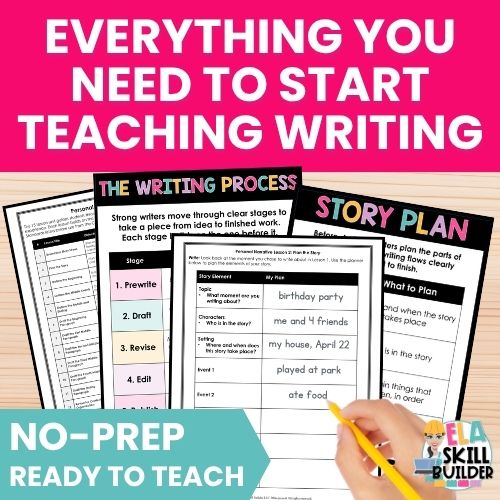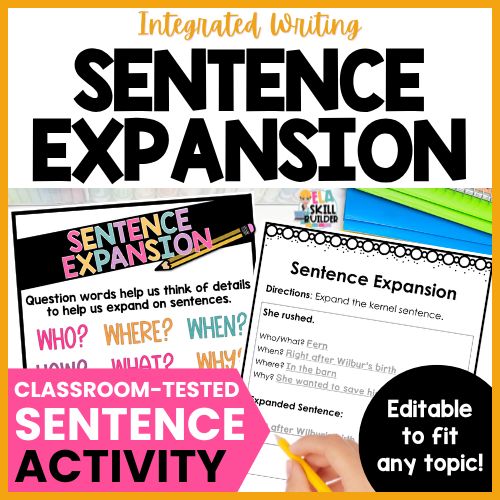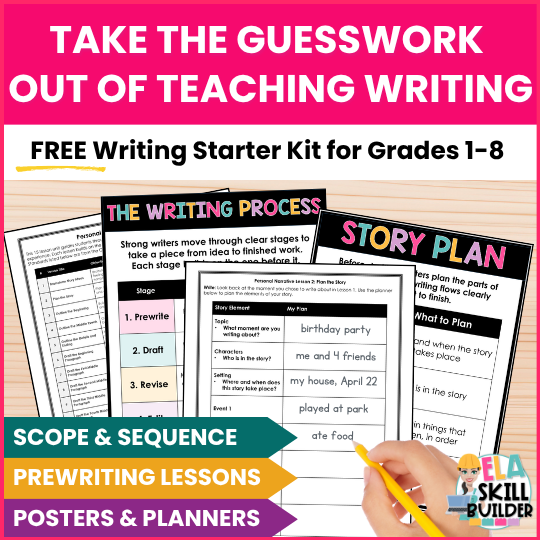
Teaching writing at home can be frustrating, especially when your child doesn’t seem to know what to write or needs your help with every single sentence.
I remember feeling that same frustration when I was teaching second grade.
I’d give my students a writing assignment, explain what I wanted them to do, and send them off to write. But within minutes, hands would start going up.
“I don’t know what to write!”
“How do I start?”
“Is this good enough?”
And before I knew it, I was running around the classroom helping one student after another. Some students finished in five minutes, while others barely wrote a sentence.
I eventually realized that the problem wasn’t that my students couldn’t write. The problem was that I was expecting them to do things I hadn’t actually taught them how to do.
Once I started breaking writing instruction into smaller, manageable lessons, modeling each skill, and giving students opportunities to practice, things started to change.
And while I was teaching in a classroom, these same principles apply to homeschooling!
If writing time at your house involves tears, frustration, or constant reminders to “just write something,” you might be making one of these five common mistakes.
The good news? They’re all fixable!
Mistake #1: Giving Writing Assignments Without Teaching Writing
It’s easy to think that if your child writes often, they’ll naturally get better. So you hand them a prompt like “Write a story about your favorite animal” and hope for the best.
But assigning writing isn’t the same as teaching writing.
When children are asked to write without being shown how, they often freeze. They stare at the page, say they don’t know what to write, or scribble a few sentences just to be done. It’s not that they can’t write. No one has shown them how yet.
Think about how kids learn to read. We don’t just hand them books and hope they figure it out. We teach sounds, words, and strategies step by step. Writing works the same way.
What to Do Instead
Before your child writes, teach one specific skill and show them what it looks like.
- Pick one skill. For example, writing a strong beginning or adding details.
- Show an example. Read a short example from a book, or write one yourself.
- Think out loud. As you write, explain your choices: “I want the reader to picture this, so I’m going to add what it smelled like.”
- Then let your child try. Now they’re practicing one clear skill, not guessing at a whole piece.
When your child sees exactly what to do, writing feels much less scary.
Mistake #2: Teaching Writing Without a Clear Plan
Many homeschool parents end up piecing writing together: a prompt book here, a workbook there, a few printables from Pinterest. It feels productive, but there’s no clear path from one skill to the next.
Without a plan, important skills get missed, and kids struggle to build on what they’ve learned. You also end up spending hours planning, wondering what to teach next, and worrying that something important is falling through the cracks.
What to Do Instead
Follow a clear progression of skills, so each lesson builds on the one before it.
- Focus on one type of writing at a time. For example, personal narrative, fictional narrative, informational, or opinion writing.
- Map out the skills for that genre. Start with planning and organizing ideas, then move to drafting, revising, editing, and publishing.
- Use a scope and sequence. It shows you what to teach and when, so you always know what comes next.
With a clear plan, you spend less time figuring out what to teach and more time actually teaching.
Mistake #3: Expecting Independent Writing Too Soon
You explain the assignment, answer a few questions, and step away to help a sibling or start lunch. When you come back, your child has written one sentence, or nothing at all.
Most kids aren’t ready to write on their own right after hearing the directions. They need to see it done, talk through their ideas, and practice with support first. Without that, they either give up or need your help with every single sentence.
What to Do Instead
Build independence gradually, with support at each step.
- I do: Model the skill with your own writing while your child watches.
- We do: Work on it together. Talk through ideas and write a few sentences side by side.
- You do: Let your child try it on their own, with a graphic organizer to guide them.
Graphic organizers are especially helpful here. They give your child a clear starting point and a place to sort their ideas before writing, so they’re not facing a blank page alone. Over time, your child will need less and less of your help.
Mistake #4: Skipping the Planning and Revising Stages
It’s tempting to keep writing simple: your child writes a draft, you fix a few spelling mistakes together, and it’s done.
But skipping planning and revising means your child misses the parts that actually make writing better. Planning helps them organize their ideas before they start. Revising teaches them to add details, make their writing clearer, and take pride in the finished piece.
What to Do Instead
Walk your child through the full writing process, one stage at a time:
- Prewriting: Brainstorm ideas and plan with a graphic organizer.
- Drafting: Write a first draft using the plan.
- Revising: Make the writing stronger by adding details, using more interesting words, or reordering ideas.
- Editing: Check spelling, capital letters, and punctuation.
- Publishing: Write a clean final copy and share it with family.
You don’t have to rush through all five stages in one day. Spending a few days on each stage gives your child time to really learn each step. And when they read their finished piece to grandma, you’ll both see how much they’ve grown.
Mistake #5: Only Teaching Writing When There’s Extra Time
Math gets done. Reading gets done. But writing? It often gets pushed to “later,” and later doesn’t always come.
This usually happens for understandable reasons. You’re not sure what to teach, you don’t have time to plan a lesson, or the day just got away from you.
But when writing only happens once in a while, children don’t get the steady practice they need to grow. Each time feels like starting over, which makes writing feel even harder.
What to Do Instead
Make writing a short, regular part of your day, just like math or reading.
- Keep it short. Even 20 to 30 minutes a day is enough when the lesson is focused on one skill.
- Follow the same routine. Teach the skill, model it, then let your child write. When every lesson looks the same, it’s easier to start.
- Have lessons ready ahead of time. When you don’t have to plan from scratch, writing is much less likely to get skipped.
A small amount of writing each day adds up quickly. Within a few weeks, you’ll likely notice your child getting started faster and writing with more confidence.
Try This: Free Fictional Narrative Writing Lessons
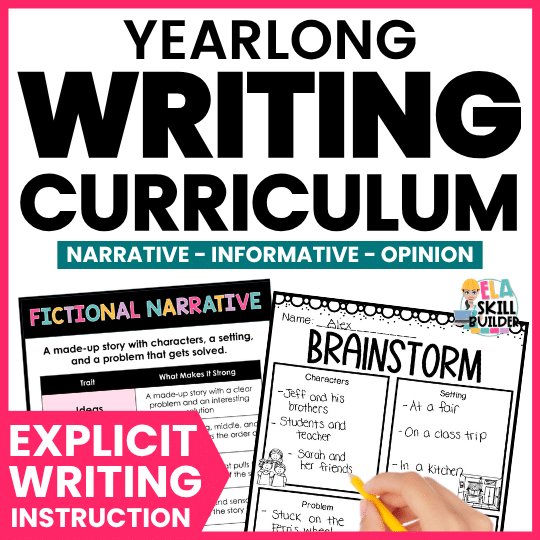
Ready to try a simple, step-by-step approach at home? Grab my free fictional narrative lessons. Each lesson teaches one skill, includes a ready-made writing sample you can model with, and gives your child a clear activity to practice. Just print and teach, no planning required. Download Your FREE Fictional Narrative Writing Lessons Here!
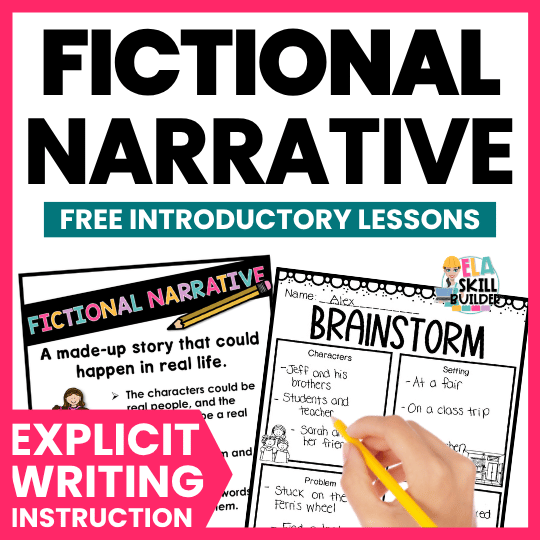
Download Your FREE Fictional Narrative Writing Lessons Here!
About Jen Goasdone
Jen Goasdone is a certified elementary teacher, a mom, and the founder of ELA Skill Builder LLC. After years in the classroom and years more creating writing curriculum, she knows how hard it can be to teach writing without a clear plan. She creates simple, step-by-step writing and grammar resources that help homeschool parents teach with confidence, even without a teaching background.