Are you frustrated that your students (or your own kids, if you’re teaching at home) aren’t actually using the grammar skills you’ve taught them?
You’re not alone. I used to spend so much time teaching grammar. Fun songs, cute videos, engaging activities, workbook pages, you name it. And honestly, my students did great with all of it. They seemed to understand the grammar concepts really well.
But when it came time to write? Their papers were still filled with grammar mistakes.
That didn’t sit right with me. The goal of grammar instruction isn’t to just complete a worksheet correctly or pass a test. It’s to help kids become stronger, clearer writers, whether you’re teaching a full classroom or working one-on-one at your kitchen table.
If you want to avoid the common pitfalls I fell into, check out my post on the 5 biggest mistakes I used to make teaching grammar.
So I dug into the research and discovered what many of us are missing: grammar needs to be taught in the context of writing if we want kids to actually apply what they’ve learned.
The good news? There’s a simple weekly routine, just 10 minutes a day, that makes teaching grammar in the context of writing easy so your students actually use it in their own writing. I’ll walk you through exactly how it works in this post.
Before you get started, pick one grammar skill to focus on for the week. Then follow the routine below, which takes just 10 minutes a day and is proven to help kids understand and apply grammar skills.
Before we dive into each day, here’s a quick look at the whole routine:
- Day 1: Notice the skill in a mentor sentence
- Day 2: Teach the skill with an anchor chart
- Day 3: Practice the skill with an imitation sentence worksheet
- Day 4: Apply the skill in authentic writing
- Day 5: Assess the skill in an authentic assessment
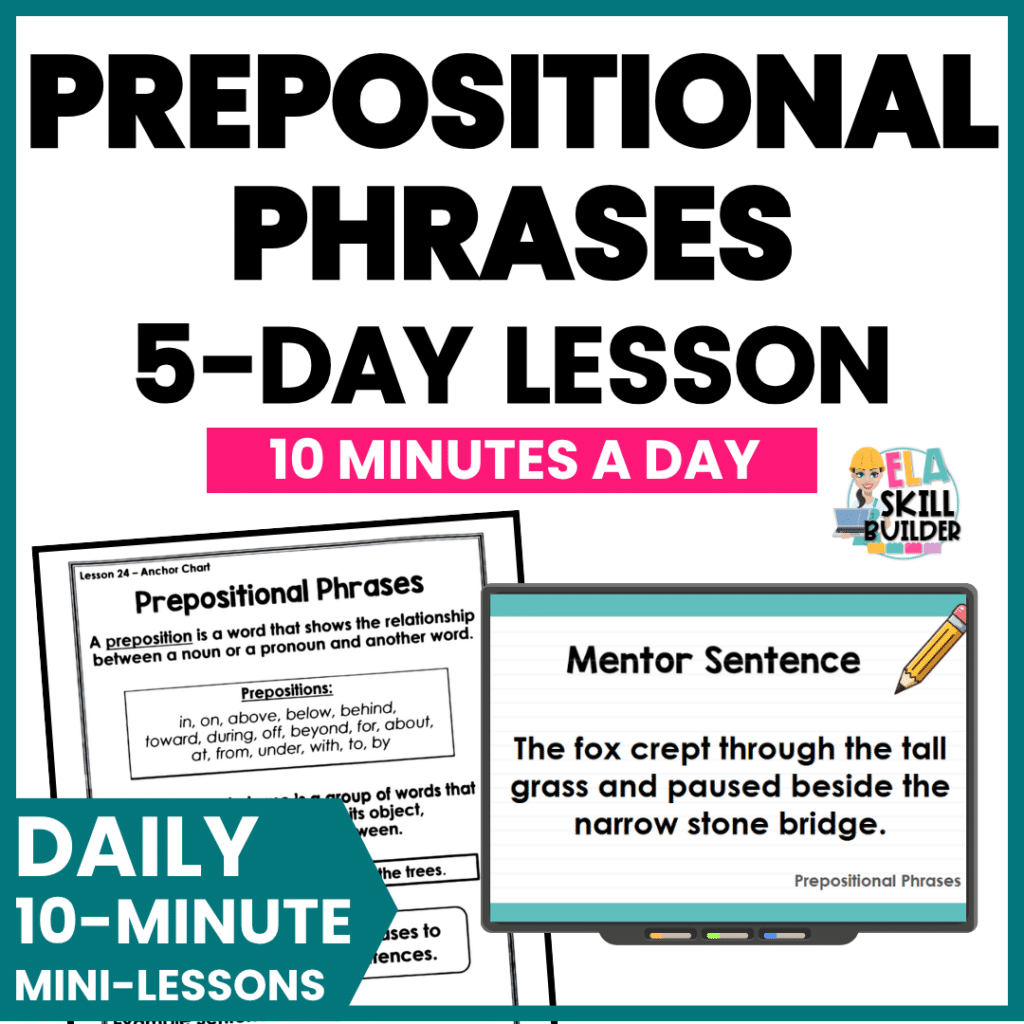
Grab a free 5-day prepositions lesson here.
Day 1: Notice the skill in a mentor sentence
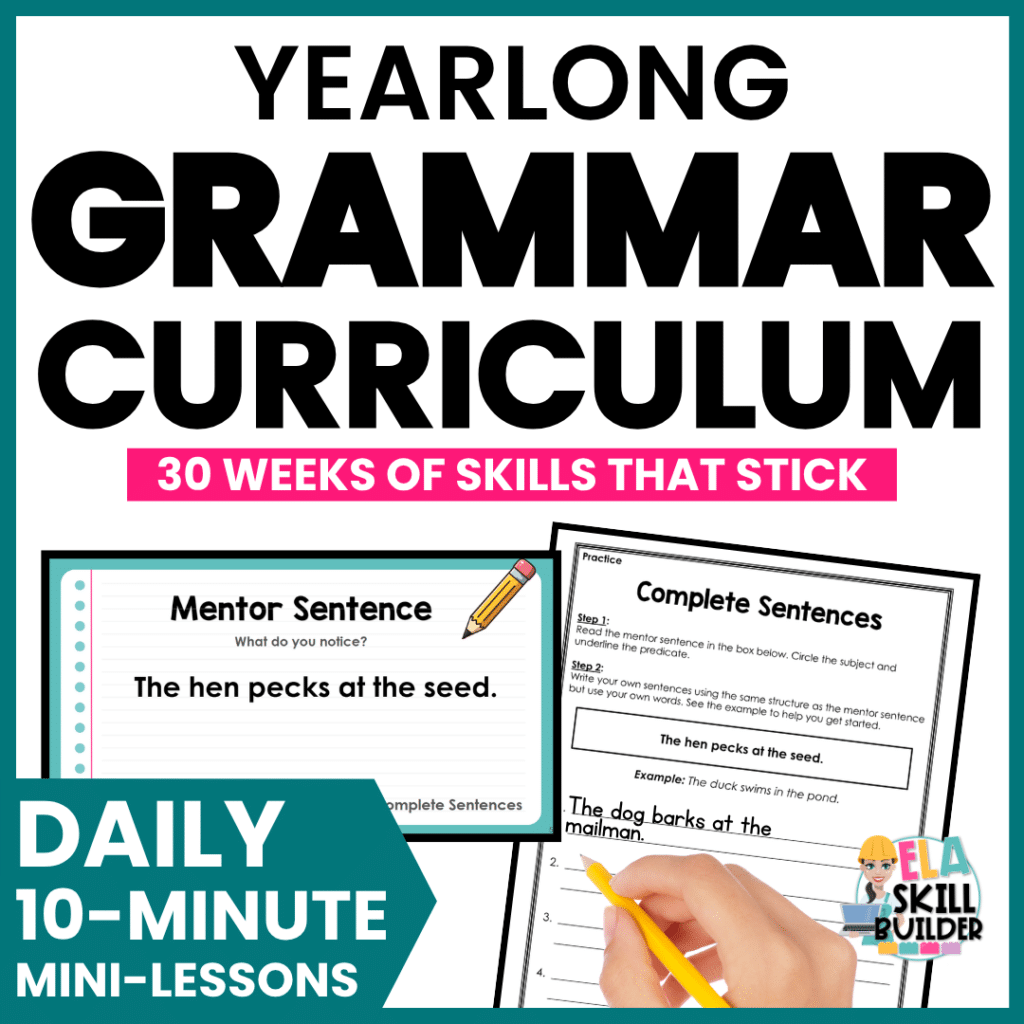
On Day 1, you’ll introduce the weekly grammar skill using a mentor sentence. A mentor sentence is a carefully selected sentence from real writing that shows how an author uses grammar to add clarity, detail, or meaning.
Why mentor sentences?
Mentor sentences help kids see how grammar works in the context of actual writing, not just as a list of rules to memorize. Instead of starting with a definition, students begin by noticing how the grammar skill shows up in writing that feels authentic and meaningful.
This inquiry-based approach is engaging because it gives kids a clear purpose for learning the skill. They’re not just memorizing parts of speech or punctuation rules, they’re discovering how grammar makes writing stronger and easier to understand. That sense of discovery is what makes them want to try the skill out for themselves, which is what helps it stick.
👉 Want to dig deeper into why mentor sentences work so well? Check out my full blog post here.
Steps for this mini-lesson:
- Read the mentor sentence. Read it aloud, then read it together chorally to help kids internalize the structure and rhythm of the sentence.
- Example: The fox crept through the tall grass and paused beside the narrow stone bridge.
- Invite kids to notice and share what stands out. Ask an open-ended question like, “What do you notice about this sentence?” Let them comment on anything that stands out, grammar, word choice, punctuation, or structure. Eventually point them to the targeted grammar skill. (e.g. prepositional phrases)
- Example: “The author uses phrases like ‘through the tall grass’ and ‘beside the narrow stone bridge’ to tell us where the fox is.”
- Discuss the purpose. Ask questions like, “How do these phrases help the writing?” or “What would the sentence be like without them?”
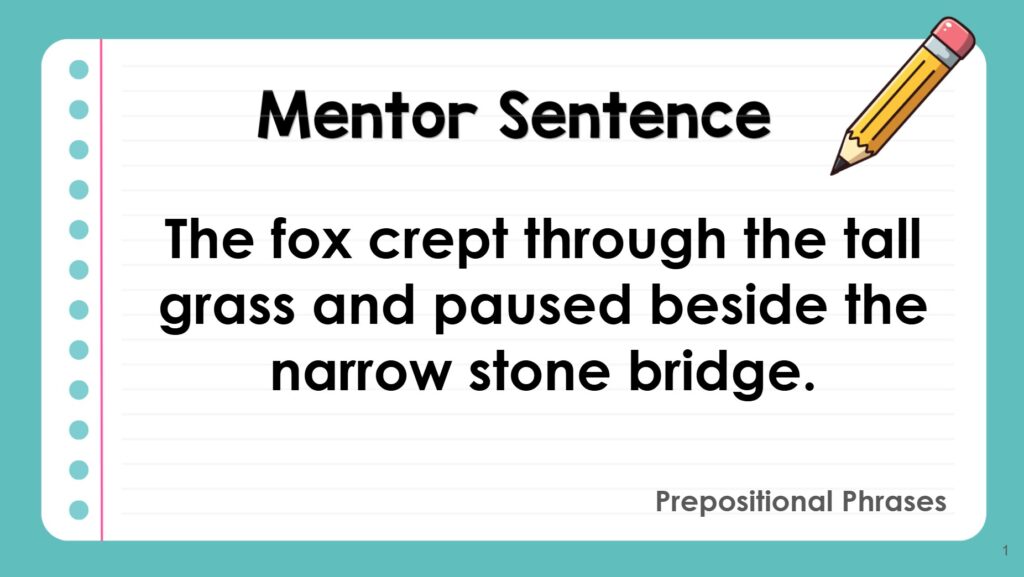
On Day 1, ask your students what they notice in a mentor sentence. Watch this video demonstration to see the mini-lesson in action.
Day 2: Teach the skill with an anchor chart
On Day 2, you’ll build on what kids discovered during the mentor sentence lesson. It’s time for some direct instruction to clearly define the grammar skill and give students a tool they can return to again and again. Together, you’ll create an anchor chart that explains the skill using clear definitions, rules, and examples.
This explicit teaching helps solidify understanding, and it’s far more effective and meaningful when it comes after kids have already seen the skill in action.
Why grammar anchor charts?
Anchor charts make learning visible. When you build one for each skill you teach, you’re creating a go-to reference kids can use as they write. It reminds them of what they’ve learned and how to apply it, cuts down on repeated questions, and gives them the confidence to self-check their own work.
Rather than handing out a pre-made poster or rule sheet, building the chart with your students, or working through it together at home, increases ownership, clarity, and retention.
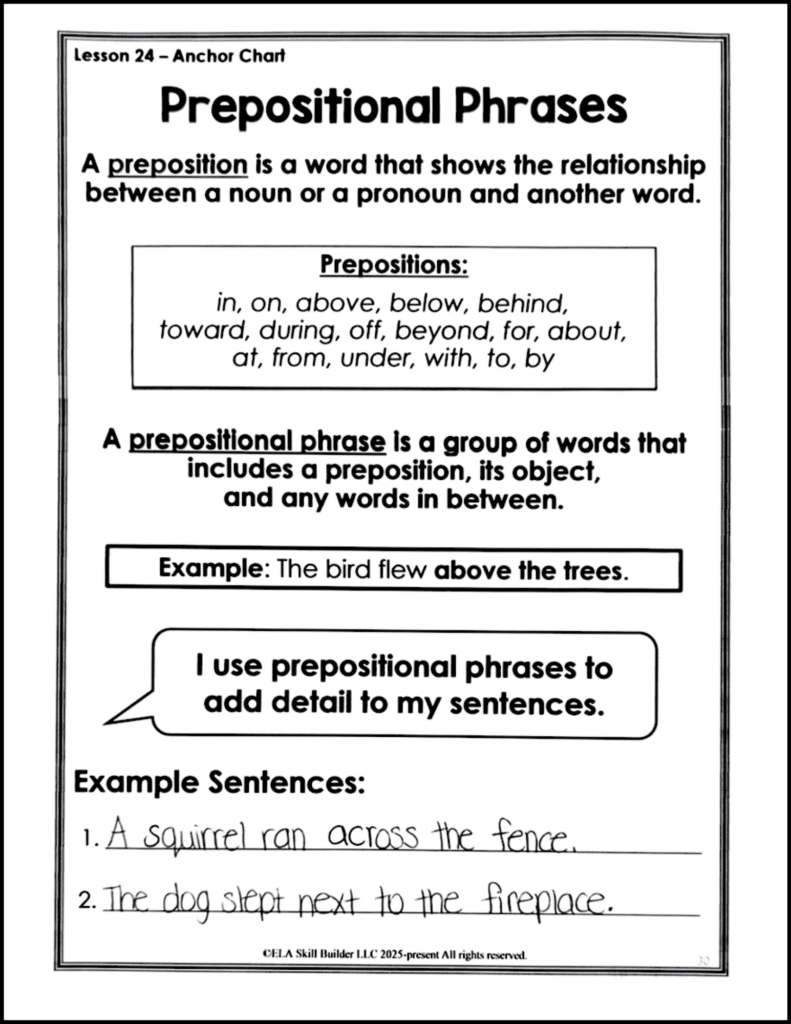
On Day 2, create an anchor chart with your students to help them retain definitions and rules. Watch this video demonstration to see the mini-lesson in action.
Steps for this mini-lesson:
- Create the anchor chart. Work together to summarize the key terms, definitions, rules, and example sentences.
- Model example sentences. Write a few example sentences together to show how to use the skill correctly.
- Display it for reference. Post the anchor chart somewhere kids will see it while they write, whether that’s on a classroom wall or in a binder at home.
Day 3: Practice the skill with an imitation sentence worksheet
On Day 3, students shift from noticing and discussing grammar to actually using it in their own writing. This is where the skill starts to stick. Using an imitation sentence worksheet, kids write sentences that mimic the structure of the mentor sentence from Day 1.
Writing imitation sentences gives kids a chance to try the skill in a structured, supported way. It’s focused and purposeful, and far more effective than isolated activities like correcting grammar errors or identifying parts of speech.
Why imitation sentences?
Imitation sentences bridge the gap between understanding a grammar skill and using it in writing. Instead of practicing in isolation on a worksheet full of unrelated examples, kids apply it in complete, thoughtful sentences that resemble real writing.
Because they’re working from a clear model, kids are more likely to use the skill correctly. This kind of guided practice builds writing confidence and helps the skill transfer into independent work.
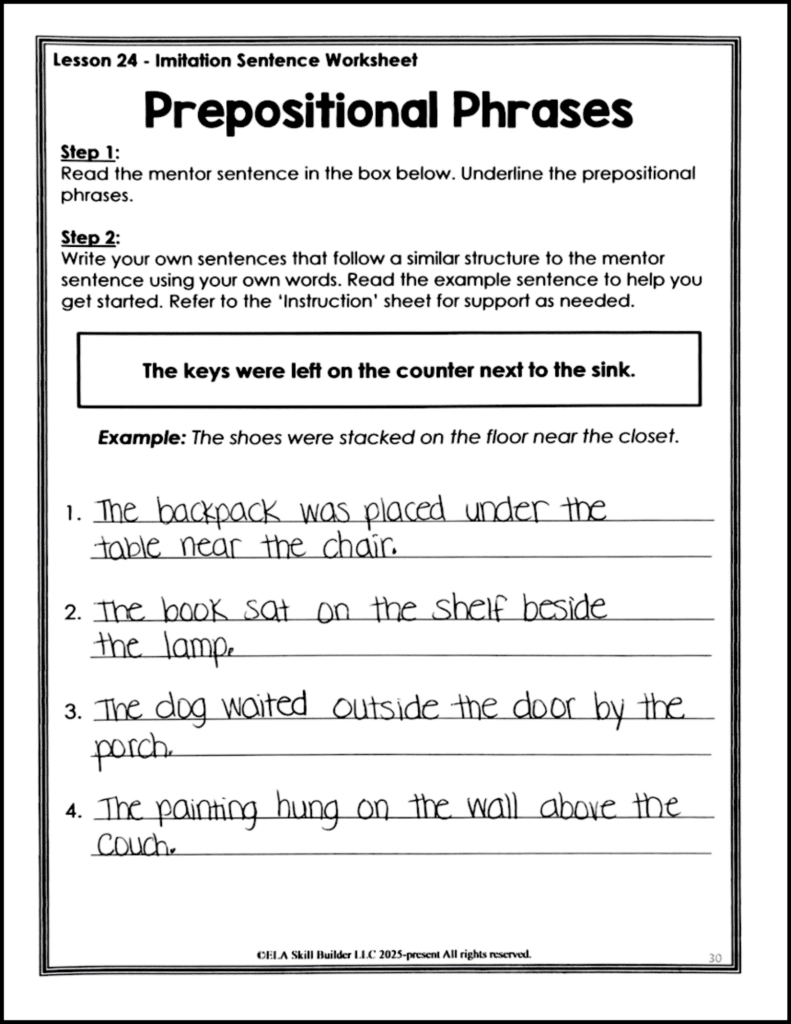
On Day 3, invite your students to write imitation sentences that resemble the mentor sentence. Watch this video demonstration to see the mini-lesson in action.
Steps for this mini-lesson:
- Review the mentor sentence. Start by revisiting the mentor sentence from Day 1.
- Example: The fox crept through the tall grass and paused beside the narrow stone bridge.
- Write a shared imitation sentence. Work together to create a sentence that imitates the mentor sentence’s structure and grammar skill.
- Example: The children ran across the sandy beach and stopped near the old wooden dock.
- Independent practice on the worksheet. Have kids write their own imitation sentences on their imitation sentence worksheet, independently, with a partner, or with you.
- Example: The dog wandered through the quiet park and rested under the shady oak tree.
Day 4: Apply the skill in authentic writing
On Day 4, kids move from practicing the skill in imitation sentences to using it on their own in real writing. This is application practice: instead of another worksheet built around isolated drills, they read a short piece of writing, complete an activity tied to it, and then write their own sentences using the skill.
Why authentic application?
This is the step that turns “I can do this on a worksheet” into “I actually use this in my writing.” Application practice asks kids to use the skill the same way real writers do: in context, with purpose, not just in a fill-in-the-blank format.
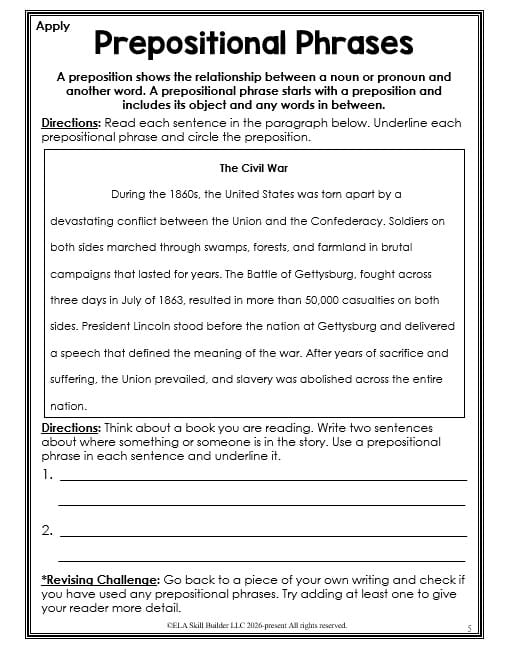
On Day 4, have students identify the skill in real writing, then write their own sentences using it, and finally revise their own writing to include it.
Steps for this mini-lesson:
- Read the overview and directions together. Go over what the activity is asking before kids dive in.
- Read the paragraph and complete the activity. Have kids read the short piece of writing and work through the application activity tied to it.
- Write their own sentences using the skill. Offer support as needed, and celebrate their effort and progress.
- Optional: try the revising challenge. If time allows, use the optional revising challenge to send kids back into a piece of their own writing to apply the skill one more time.
Day 5: Assess the skill in an authentic assessment
By Day 5, kids have been introduced to the grammar skill with a mentor sentence, learned the definitions and rules through an anchor chart, practiced with imitation sentences, and applied it in authentic writing. Now it’s time to check what actually stuck.
Unlike a typical multiple-choice quiz or worksheet where kids just identify or correct errors, an authentic assessment asks them to apply the grammar skill in a real writing task. This lines up with the whole point of grammar instruction: helping kids become clearer, stronger writers.
Why authentic assessment?
A traditional grammar test can tell you if a student recognizes a skill, but it won’t tell you if they can use it meaningfully in their own writing. Authentic assessment gives you a clearer picture of how well the skill transfers. It’s the difference between knowing the rule and actually using it to communicate better.
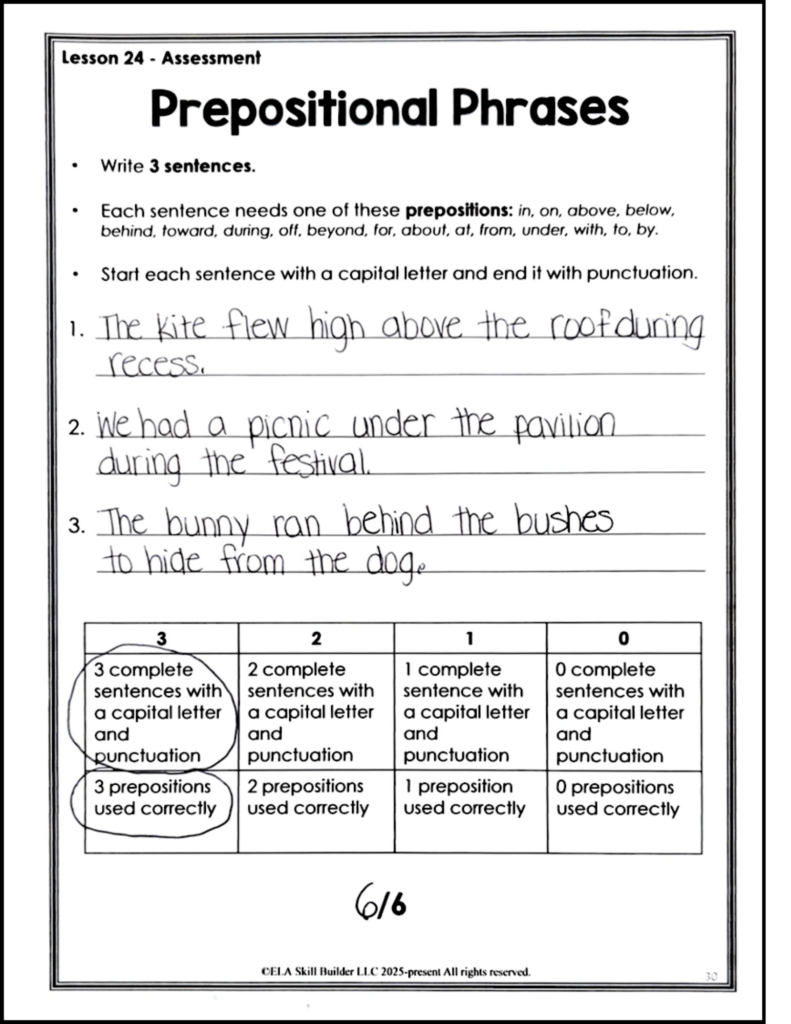
On Day 5, wrap up the routine with an authentic assessment. Watch this video demonstration to see how the assessment works..
Steps for this mini-lesson:
- Give kids a writing prompt that requires the skill. Design a prompt that has students write a short paragraph or a few sentences where they naturally use the skill. For example, if you’ve been focusing on proper nouns, the prompt might ask them to write about their favorite place or person, which naturally calls for specific names.
- Use a simple rubric focused on the skill. Keep it to a few clear criteria, like “3 sentences with beginning capitals” and “each sentence has an action verb.” Share the rubric with kids so they know what’s expected.
- Have kids self-assess first. Let them check their own writing against the rubric before you collect it. This builds their awareness of grammar and ownership of their learning.
- Score it and plan next steps. Look for patterns in who’s applying the skill well and who might need more practice or reteaching, whether that means a small group, a one-on-one check-in, or a second pass at home.
Grab it: 5-Day Prepositions Lesson
Ready to help your students actually use grammar in their writing, at school or at home?
Grab this free, classroom-and-homeschool-tested 5-day prepositions lesson that uses this exact routine.
👉 Download this prepositions lesson now and start seeing the difference in your students’ writing.
Conclusion
I’ve seen so many teachers and homeschool parents try this 5-day grammar routine and watch their kids actually start using grammar skills in their writing, not just on worksheets, but in real, meaningful ways.
It’s amazing how just 10 minutes a day, focused on clear, purposeful practice, can make such a big difference. If you’ve been frustrated by grammar instruction that doesn’t stick, whether you’re running a full classroom or teaching one or two kids at home, this routine could be exactly what you need to simplify things and boost your students’ confidence as writers. Give it a try, and I’d love to hear how it goes.
About Jen Goasdone
Jen Goasdone, the owner of ELA Skill Builder, is a dedicated educator committed to empowering teachers and homeschool parents with simple, research-based strategies for effective writing instruction. With a focus on making ELA teaching easier and more doable, Jen helps kids build a strong writing foundation that will serve them for years to come. Passionate about both grown-up and student success, she strives to make writing instruction enjoyable and effective for elementary learners, wherever they’re being taught.